

Miracle and LogicProgram explored organising program execution through interacting components. CPO extends the engineering focus to connecting intent, knowledge, decisions and human and AI actions throughout a long-running project. This continues I.V.A.’s line of research; it does not claim direct reuse of code or components from the earlier environments.
Projects
CPO IDE · People, knowledge and artificial intelligence
An environment for engineering understanding and project development.
CPO IDE is being developed as a workspace where people build and deepen their understanding of a project: define goals, explore possible solutions, establish constraints and verify results. Artificial intelligence participates in this work by helping analyse information, develop solutions and carry out delegated actions.
CPO is intended to preserve both the results of work and an understanding of why they were achieved in that particular way, what decisions were based on and what would change if the original conditions were revised.
In development · free release planned for 2027
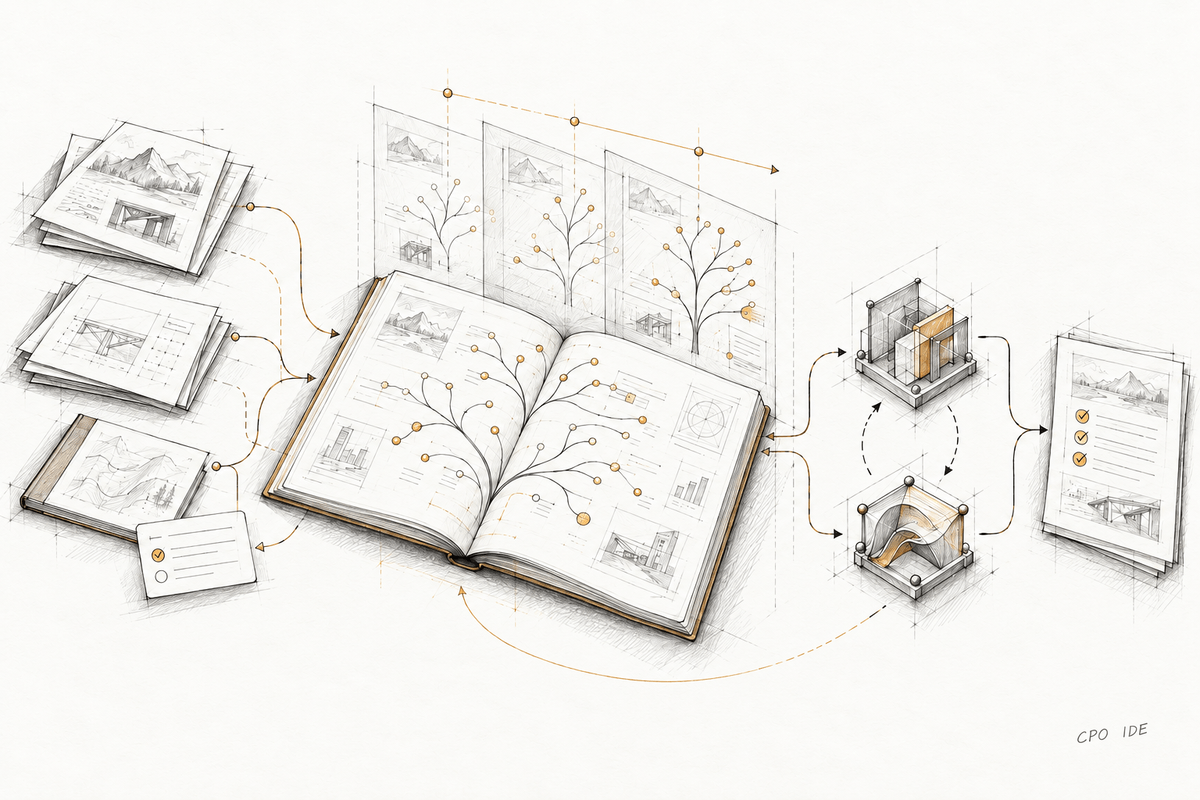
knowledgedecisionscontinuity
01
Why CPO is being developed
In a long-running project, it matters what we are creating, why we chose this approach, what has been delegated and how the result affects the project. Code, documents and completed tasks record the work done. Continuing that work also requires preserving its intent and underlying reasoning.
CPO is being developed so that a project retains its knowledge, the grounds for its decisions, its history and the logic of its execution as people, AI models and tools change. This should help people resume work after a break and reconsider decisions with an understanding of their consequences.
02
From the overall picture to the grounds for decisions
In the target model of CPO IDE, a person opens a project and sees its purpose, main areas of work, results achieved and questions requiring attention. From that overview, they can explore a particular requirement, decision or piece of work and trace its origins and relationships. Six connected views form this picture.
Knowledge — what is known about the project, where information comes from and under what conditions it applies.
Causality — why a decision was made and what it affects. Established dependencies must be distinguishable from assumptions.
Time — how the project developed and which knowledge and requirements applied at a given moment.
Decisions — what was decided, by whom and on what grounds.
Execution — who is doing the work, which goal it serves and the limits of the assignment.
Evidence — what has actually been verified and what supports the result.
These views should allow people to move from the overall intent to specific work and back. For example, when a requirement changes, it is important to see which decisions depend on it and which results need to be checked again.
03
A methodology for working with AI
CPO is based on a connected process of goals, knowledge, decisions, execution and verification. A solution proposed by AI needs justification; a completed operation needs its result checked; a successful test supports only the properties it actually tested. Hypotheses, verified facts and adopted decisions must remain distinguishable.
People determine goals, the limits of the system’s autonomy and significant decisions. CPO is intended to organise delegated work and return results together with grounds for evaluating them. Human involvement is needed where understanding, choice and responsibility are required.
The target organisation of execution connects the project owner, CPO Mentor, managers and executors. The mentor maintains the coherence of the project and continuity of decisions, managers lead areas of work, and executors handle specific tasks. This organisation is intended to reduce manual coordination within delegated authority.
04
CPO System and CPO IDE
CPO — Cognitive Project Office — defines the methodology and system mechanisms for people and AI to work together. CPO System provides the underlying foundation: maintaining authoritative knowledge and decisions, managing permissions, executing work and preserving history. CPO IDE presents this foundation to people in a unified workspace.
Dialogue with AI, knowledge exploration and access to history should all refer to the same project state. The interface should help people understand a system, make a decision, delegate its execution and assess the consequences. Technical details are revealed as needed.
The concept covers software, engineering, research and organisational projects. The first practical scenarios are being explored through software development tasks.
05
Authority and result verification
In the target architecture, delegation defines permitted operations, data access, tools and resource limits. External actions require appropriate authority; the system must not expand its own permissions. A historical decision or a stored approval does not, by itself, grant current permission for a new operation.
Execution, verification and acceptance are separate actions. Verification assesses a result against current requirements and evidence of execution; final authority over goals, boundaries and significant decisions remains with the owner. Implementation and testing of these mechanisms are ongoing.
06
Context and independence from AI providers
The context for a specific task is intended to be assembled from relevant project knowledge, requirements and decisions. A temporary conversation with a model remains a means of interaction, while project state is maintained separately. This should allow models, providers and tools to change without reconstructing agreements. Identical context does not guarantee identical behaviour from different AI models, so results still require verification.
The architecture distinguishes permission to read information, the need to include it in a task, and permission to disclose it to external AI. It calls for limiting disclosed data to what is necessary. Complete enforcement still requires implementation, integration and testing.
07
History, causes and evolving decisions
The history should answer what was known at a chosen time, which requirements and decisions applied, why they changed and what followed. This requires historical states and connections between a change, its rationale, its consequences and subsequent verification.
For example, a changed deadline constraint may require a different implementation approach and work plan. The rationale for the previous choice needs to remain available, together with an indication of which conclusions and checks must now be revisited. History can then inform the next decision rather than simply list past actions.
08
Measure of effectiveness
CPO’s measure of effectiveness is verifiable project progress with the minimum necessary user involvement, while preserving user control over significant decisions. The system should reduce the effort spent reconstructing context and manually coordinating every step. Agent counts and report volumes alone do not show whether this goal has been achieved.
09
Current development and readiness
Individual components of the Electron and React desktop IDE have been implemented, along with components for project and knowledge models, context preparation, execution and event recording. This work establishes the product’s foundation; individual components do not yet demonstrate a complete user workflow.
Work continues on integration and verification of knowledge, causal and historical relationships, authority, recovery and tool interaction. The full semantic hierarchy and access to past project states have not yet been completed as user workflows. CPO IDE remains an internal development project and is not yet available to external users.
10
Product origins and development
CPO develops a methodology and software tools for joint intellectual work by people and AI. CPO IDE is intended to connect understanding a project with developing it in practice: from investigating a question and making a decision to execution, verification and preservation of the knowledge gained.
A free release of CPO IDE and inclusion in the Russian software register are planned for 2027. These are development plans, not guaranteed dates. Paid extensions are also envisaged; their scope and timing will be determined as the product develops.
Project in the timeline
Start with your challenge