

An agreement signed with Yaroslav-the-Wise Novgorod State University to use the Miracle™ platform in scientific, technical and educational programmes
Read more ↗Projects
Development tools · 1990s
Miracle. An application built from components.
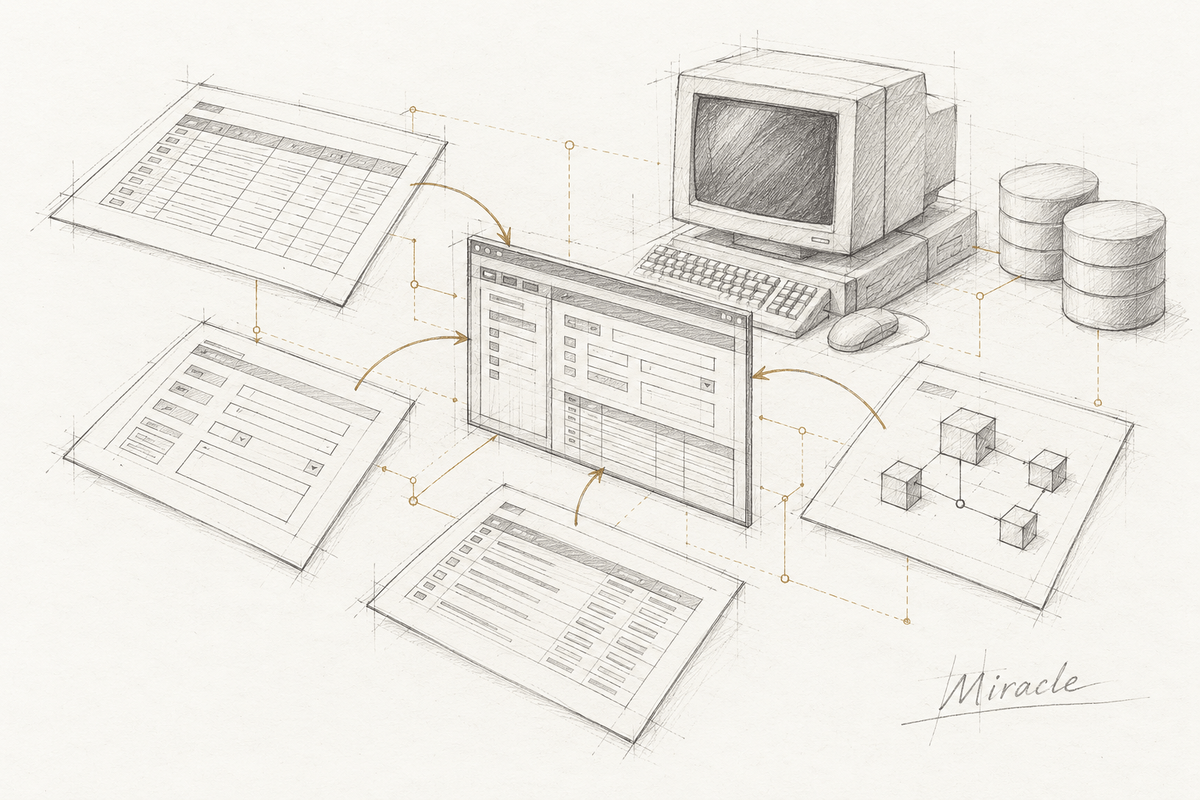
An environment for assembling data, forms, algorithms and reports into an information system by describing components and their relationships. A prototype could evolve as the task became clearer.
From the company archive
datacomponentsevolving a solution
01
Challenge
A custom information system needed more than an initial program: it had to adapt to the way an organisation worked. We sought to describe the solution in terms of its business task, using data, interfaces and interaction rules, while allowing the application to be refined incrementally.
02
Our contribution
The I.V.A. team created its own environment for developing and running client-server applications. It included database structure, screen form, algorithm and report designers, an application generator, authorisation tools, a transaction monitor and application migration tools. An API allowed specialised component libraries to be extended.
03
Solution
A C++ component performed a function and could retain state. Data connections carried values; events determined what ran next. A changed value could raise an event: entering a new number in a form might trigger a recalculation. Several components could be grouped behind a few exposed inputs and outputs. If a connection changed at runtime, the next event followed the new path.
04
Outcome
Applications built with Miracle included internet telephony accounting and billing for GSL/TELEGLOB, WorkFin for information about client assets, and FinJet for planning cash flows. In these applications, the component environment connected data processing with the rules of a particular business.
05
Miracle in a box and on CD
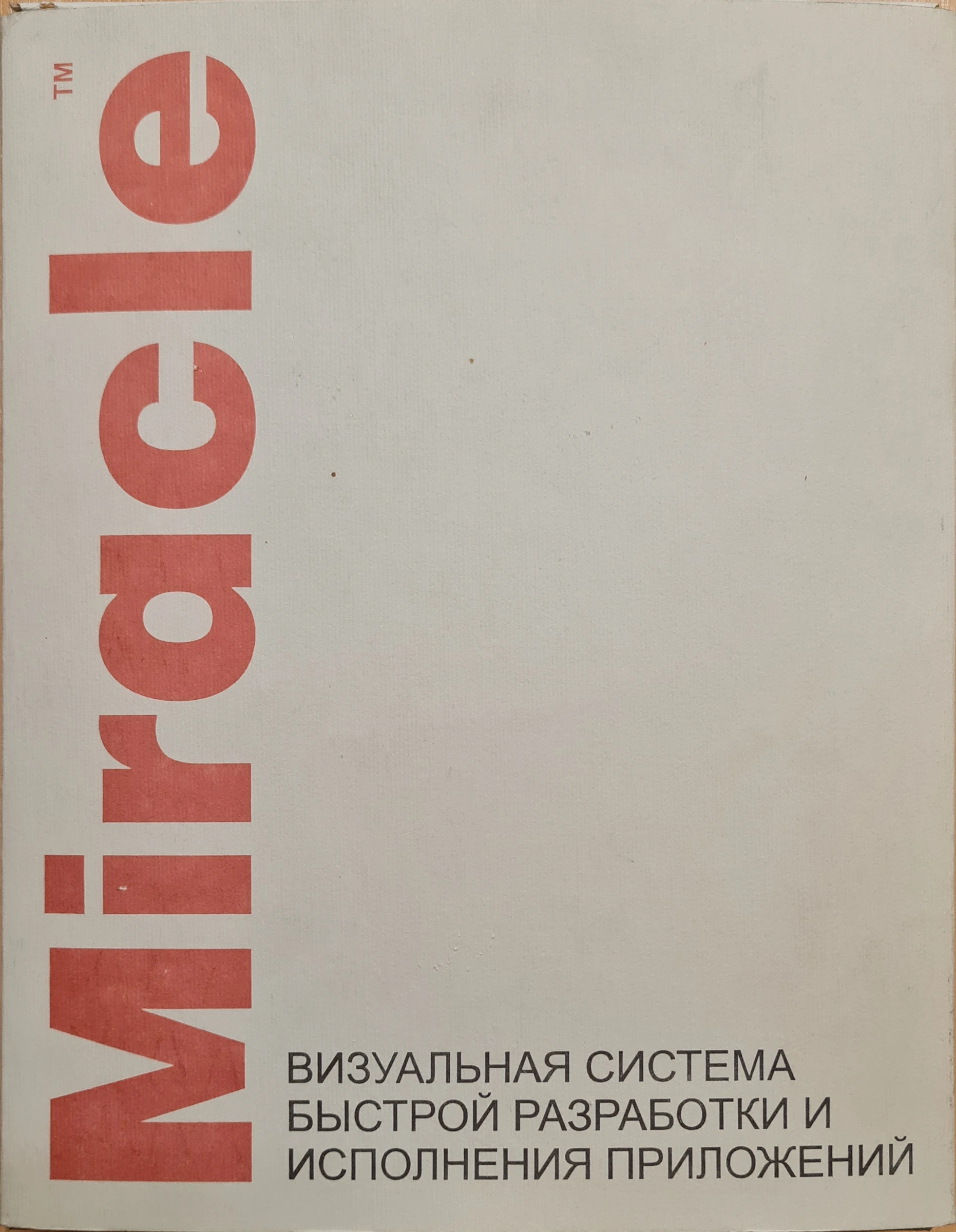
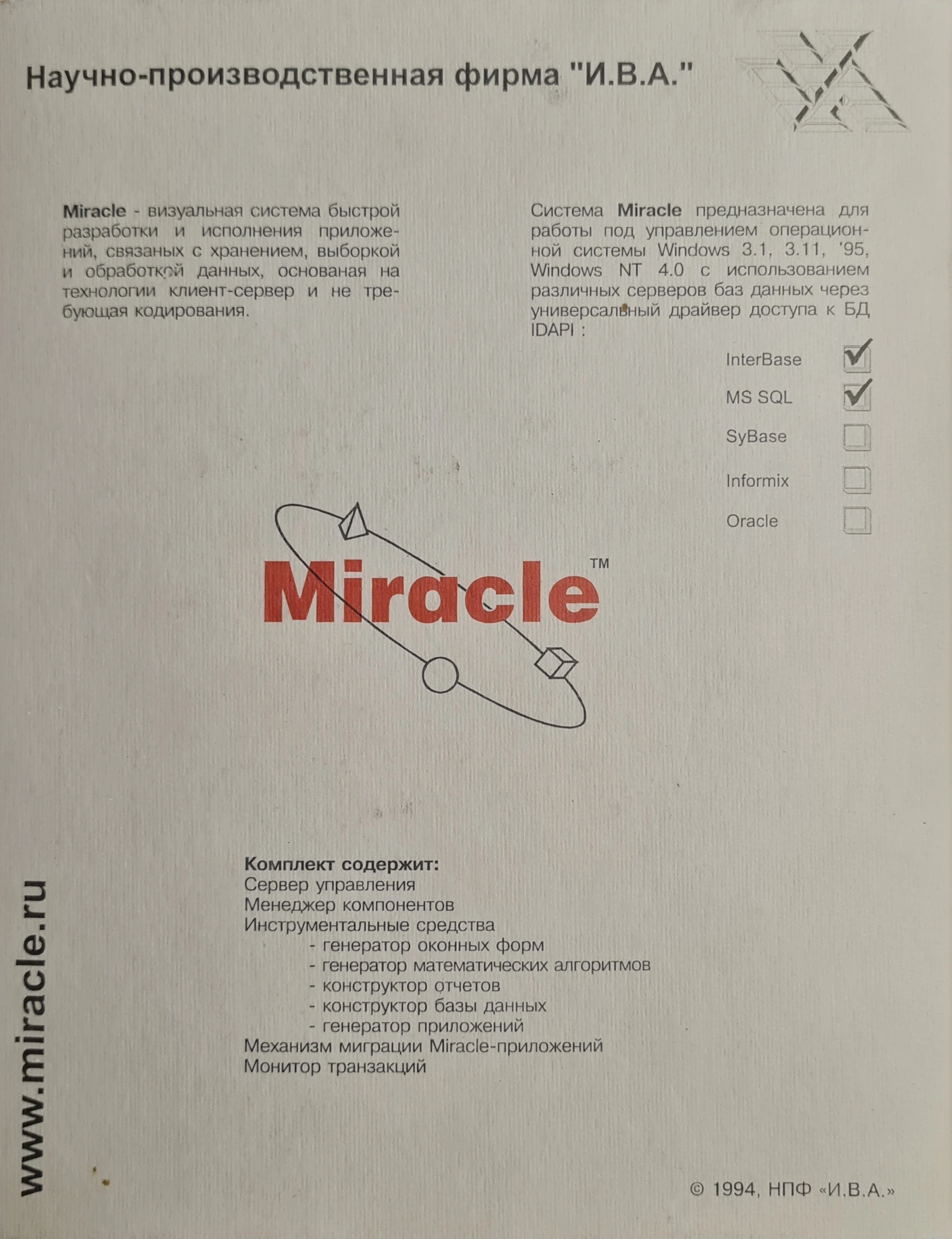
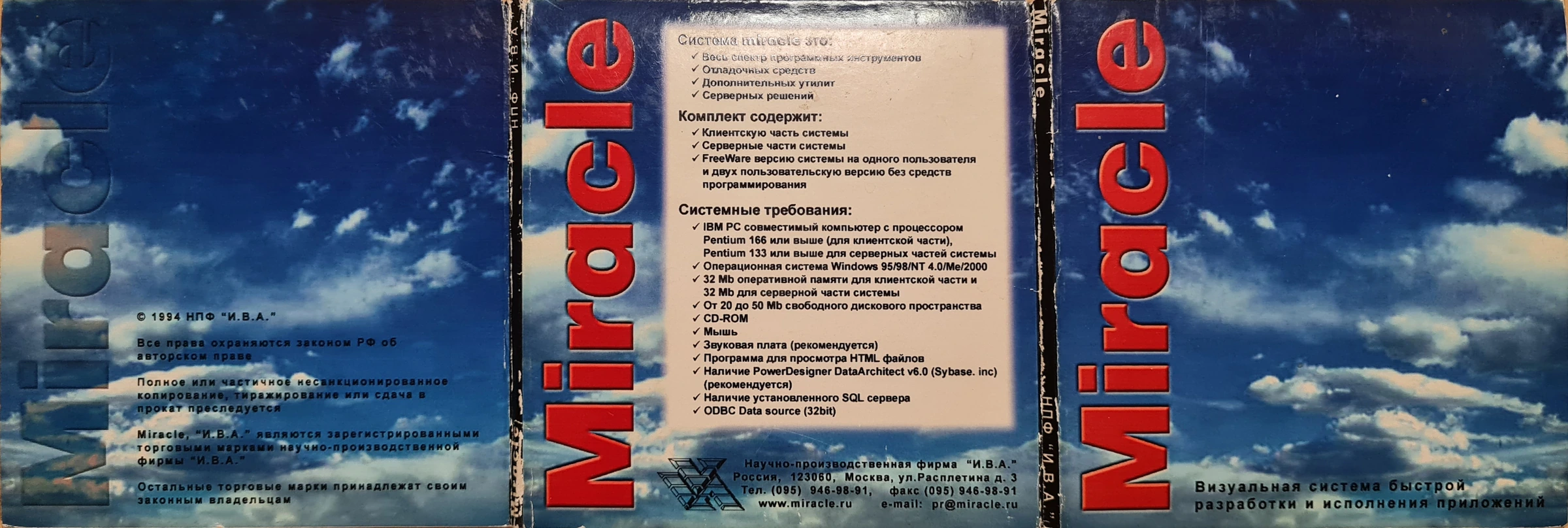
Miracle was distributed as a standalone software product. An early box survives from the version supplied on floppy disks. Its back lists the management server, component manager and tools for forms, algorithms, reports and databases. The packaging shows how the development environment was presented to users as a complete product.
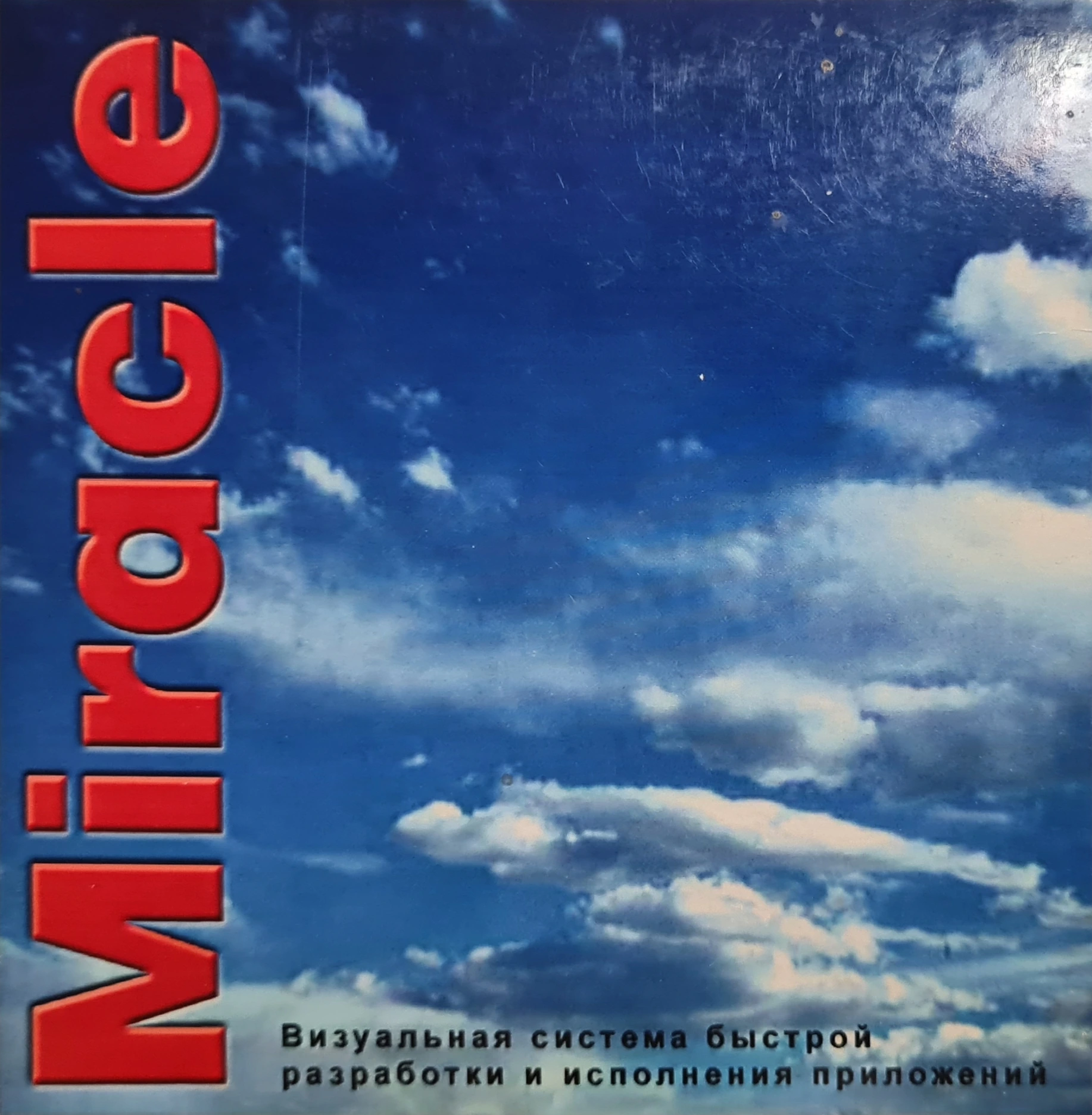
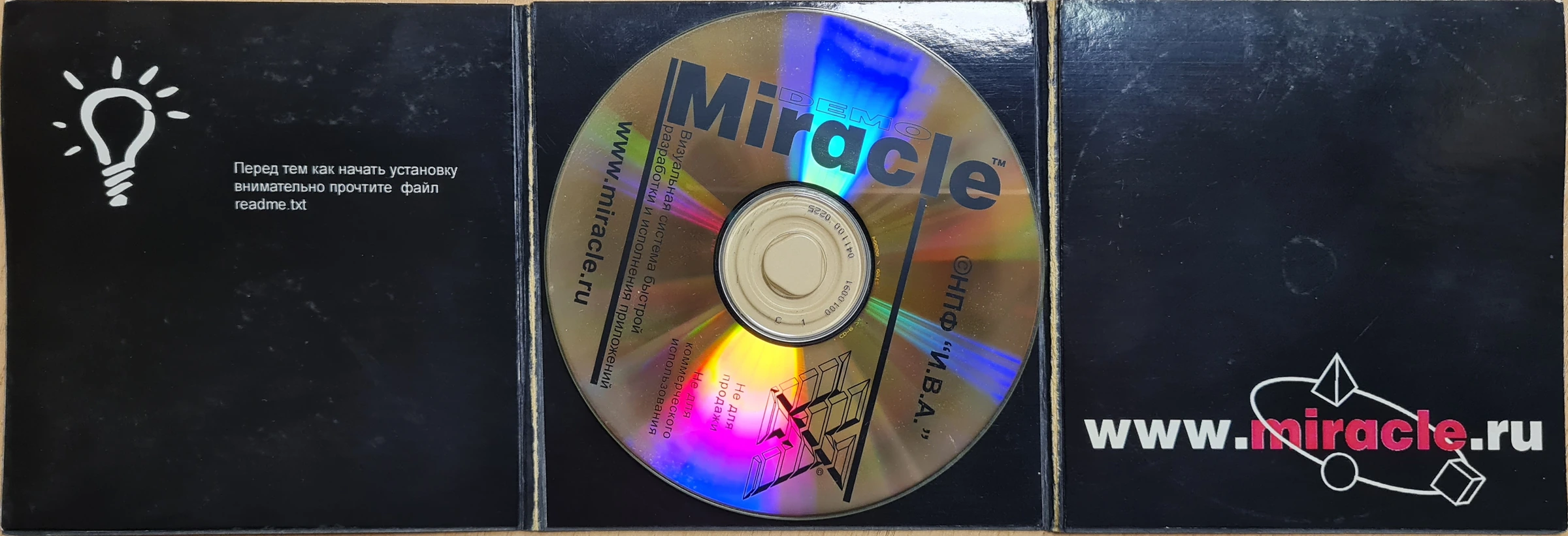
A folding sleeve and CD of the Miracle demonstration version also survive. The disc is explicitly marked “Not for sale”. These objects complement the technical history by showing the physical form in which the software was supplied for evaluation and use.
06
Technology of the period
Visual development tools already existed: NI released the graphical LabVIEW environment in 1986, and Microsoft introduced Visual Basic for Windows in 1991. These illustrate the development of the field, rather than products functionally identical to Miracle. Miracle should therefore be considered in the context of an established and developing visual programming movement.
07
Historical assessment
Miracle’s engineering value lay in combining data, interface and behaviour design with execution in an environment built for applied information systems. A significant emphasis was evolving a working prototype and changing component descriptions. For 1990s projects whose requirements developed through practical use, this provided a way to refine an application incrementally.
08
Dates and milestones
Miracle appears in the chronology in 1993. An article followed in 1997, software registration in 1998 and Miracle 32 in 2000. I.V.A. signed agreements with two universities in 2001. By January 2002 the team had built a new engine and tools for graphical and console forms. Miracle Plus and LogicProgram later continued this line of development tools.
09
From Miracle to LogicProgram
In the 1990s, I.V.A. developed Miracle, an environment in which engineers built programs from ready-made components. They specified where a component received its data and, separately, which event triggered processing. Connections could be changed while the program was running. Applications built with Miracle included IMS for AeroMar. Miracle Plus later extended this model to hardware, and LogicProgram added a runtime for Android.
10
Comparison with Node-RED
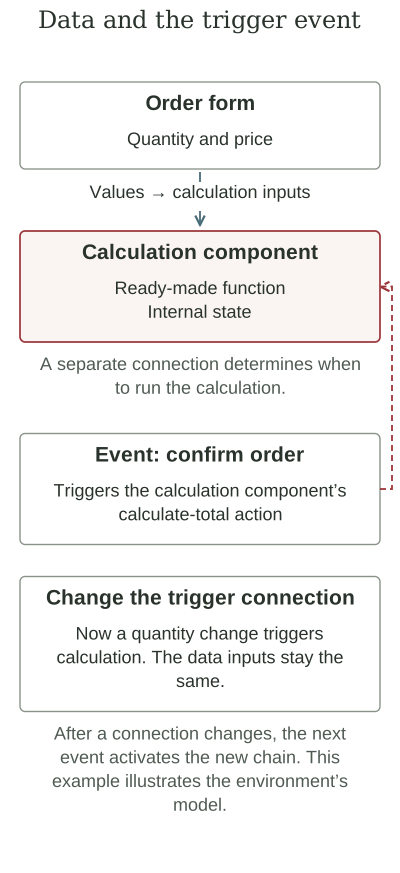
Node-RED, which began in 2013, offers a modern parallel. In both environments, the connections determine how the program behaves at runtime. In Node-RED, a node typically starts processing when it receives a message carrying data. In Miracle, the engineer specified the transfer of a value separately from the event that triggered an action. For example, an order form supplied the quantity and price for a calculation. The engineer could choose whether to recalculate when the quantity changed or when the order was confirmed.
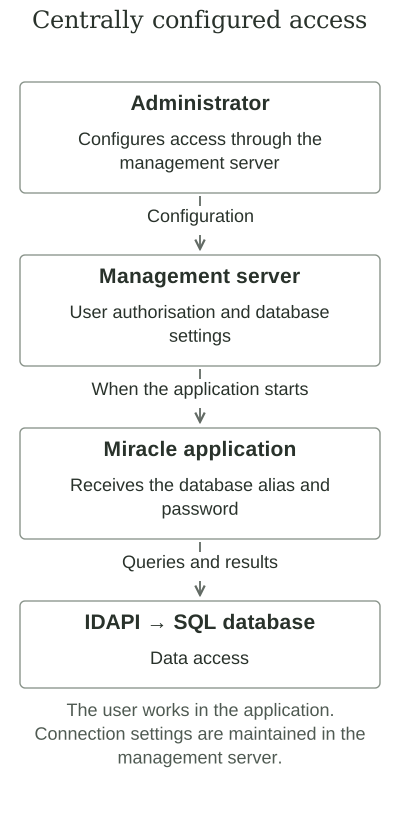
Diagrams and surviving Miracle packaging

From company records
Materials
Project in the timeline
An agreement signed with Ivanovo State Textile Academy to use the Miracle™ platform in scientific, technical and educational programmes (lectures) conducted by the university
Read more ↗Miracle 32
Read more ↗Partnership agreement with ОДО «АГРИСистемс» to promote Miracle software in the Republic of Belarus
Development of WorkFin software
Read more ↗Research and development work on the analysis and design of the database structure for “Settlement accounts”, for AeroMar (Miracle)
Read more ↗Sale of a non-exclusive licence to use the computer program (Miracle — ЗАО АэроМар)
Read more ↗Registration of Miracle software
Read more ↗Transfer of non-exclusive economic copyright rights (Miracle — ООО ИАЦ Аналайз)
PC Week/Russian Edition weekly, No. 39 (113): the article “Rapid application development technology — Miracle”
Miracle™ — an environment for rapid software design and execution, supporting a method of constructing solution models based on a non-algorithmic process for controlling program structure and data flow.
Read more ↗Start with your challenge